Category: Wifi
-
AirCheck G2 v3.0; Building on a Wifi Testing Stalwart
There are many good things continuing to happen with everyone’s favorite wifi troubleshooting tool from Netscout. The AirCheck G2 will have new firmware released this coming week on Tuesday, October 23. These new features expand on the tool’s already great feature set and should have any engineer feeling even more confident while troubleshooting. Version 3 is bringing many new features to your AirCheck. Upgrading the AirCheck G2 becomes easier to upgrade with over the air firmware upgrades. The only requirement to take advantage of this new feature is to have a current support contract. This is a great time saving new feature. Another feature new to the Aircheck will be the ability to share your profiles with other AirChecks within your organization. A profile can now be easily uploaded to Link-Live and shared among other AirChecks under your control. Adding to Link-Live’s new versatility is the ability to upload full AutoTest and Connectivity results, session files, screenshots, and packet captures. I pulled a packet capture for my iPhone after recently upgrading and saw the new option to upload to Link-Live. I simply selected the Link-Live feature, logged into Link-Live and found my pcap ready for analyzing. This builds on the ability to quickly transfer a pcap to a USB drive which can be connected directly to the AirCheck. Enhanced AP naming support has been added to get a better idea of which AP you are currently working with. APs from Cisco, Aruba, Huawei, Aerohive, and Extreme Networks are currently supported. Hopefully Fortinet will be added soon. I still rely heavily on my AirCheck G1 for identifying Meru/Fortinet APs due to it’s ability to read the AP ID information element. I continue to patiently wait… Improved packet captures allow the user to start and stop the packet capture on a specific device or channel. As mentioned previously, you can also now upload your packet capture to Link-Live for easy sharing of data with others in your organization. Another major enhancement is the ability to transfer certificates directly to the AirCheck using a USB device. I know this was a request in the past and the good people at Netscout listen to their customers! By now many of you may know that Netscout sold their “tools” to StoneCalibre, a private equity firm, on September 14. Netscout presented their future plans for the AirCheck and LinkRunner at Mobility Field Day 3 on the same day that the deal occurred but the formal announcement wasn’t made until the following Monday, September 17. Netscout was clearly aware of what was going to happen but still had a detailed roadmap for their products going forward. Their confidence seemed to be at an all time high and didn’t appear there was any reason for concern. I am still very confident in the product line going forward and am excited to see where this deal takes them. If you have a current support contract with Netscout, get ready to download the new firmware this coming Tuesday, October 23. There are many more features included that I didn’t mention in this post that will enhance the usability of an already great product. -
From the Edge to the Air, Fortinet’s Full Stack End to End Solution
As much as I hate to admit it, Fortinet is more than just “those guys who bought Meru.” In fact they are way more than just a wireless company. As we already know, Fortinet is best known in the industry as a security company with a rock solid reputation. The truth is, Fortinet is a true end to end solution, beginning with their FortiGate, moving through their switching, and into their wifi.
Fortinet’s wireless solution is broken into three distinct management platforms; FortiGate, FortiCloud, and controller (WLC). Check out one of my blog posts from earlier in the year where I broke down the differences here.
Until recently I had been mostly unfamiliar with anything but the controller solution which is built on the legacy Meru product. As most of you already know I have an affinity for the FortiRu product line which goes beyond the controversial Single Channel Architecture. The hardware is rock solid and it seems as though their code is a lot less buggy than what I hear from customers of other vendors. The cloud managed solution also seems to be a very viable solution as it chugs along in the lab at my house. This is of course a far cry from a true enterprise deployment but from what I know it seems to be reliable. Compared to other cloud managed competitors who have been around awhile, the one downside to Fortinet’s cloud managed solution is it could stand to be somewhat more intuitive during configuration. In Fortinet’s defense, it is hard to stay unique, not re-invent the wheel, and yet remain intuitive in an already saturated cloud managed playing field. The third management option is via a FortiGate. In all honestly, I have not tried this method before so I shouldn’t comment until I am more familiar. I have been graciously provided a FortiGate 81E as well as FortiSwitch 108E to check out but haven’t had the time to dive in yet.
Those who aren’t familiar with Fortinet should pay very close attention to their licensing platform. Aside from a select few products, THERE ISN’T ONE! You don’t need to sift through confusing price lists to find licensing for APs, firewall features, etc because there are no additional licenses required to operate the equipment you bought! If there is one thing that sticks in the craw of IT professionals these days, it is licensing that needs to be considered for what seems like every single feature/widget that comes with “Box X.” Not only do you have to think about the confusing and cumbersome licensing when you purchase “Box X,” you have to deal with it each time those licenses come up for renewal. Not with Fortinet! Reliable hardware, mostly stable code, and no licensing should move Fortinet onto your short list for consideration the next time you are evaluating equipment for your next purchase, and give you comfort in it’s potential to be a that true end to end solution.
Check out the following videos from our visit with Fortinet at MFD3 below.
Fortinet Company Introduction: From Security to Wireless with Chris Hinsz
Fortinet Portfolio Overview: Access Points and More with Chris Hinsz
Fortinet FortiGate as a Wireless Controller: Bringing the Security Fabric to the Edge with Koroush Saraf
Fortinet FortiGate Demonstration with Koroush Saraf
Fortinet Wireless Analytics: Birthed in Retail, Applicable to Everyone with Koroush Saraf
For those who lived through the Meru presentation a few years ago at Wireless Field Day 5, many were left with questions about Single Channel Architecture. This year Ted Fornoles gave a brief presentation on how the “special sauce” behind Single Channel Architecture actually works. Ted is one of the last remaining “Original Gangsta” Meru guys left within Fortinet. More time could have been spent here but overall the presentation was great. Although no questions were asked, there were still some skeptics in the room. I know it works, Fortinet knows that it works, but there are some out there who will always refuse to accept SCA as a viable, scalable option regardless of what is said. I stick to my original position on Fortinet’s publicity of Single Channel Architecture. If you aren’t already familiar, check out a blog post from earlier in the year here. I wish there was more talk about SCA from Fortinet’s camp as their silence gives off the appeal that they don’t have confidence in Single Channel Architecture going forward. Even though SCA has been around for several years now, and is getting somewhat long in the tooth without further advancement, there has to be something Fortinet can do to bolster the SCA solution and make it a heavy hitter in future wireless adaptations. Check out Ted’s video explaining Single Channel Architecture below.
Fortinet Virtual Cell & Single Channel Demystified with Ted Fornoles
A Very Special Thanks
As many of you know I use FortiRu gear to provide wifi to 100,000ish students and staff every day at Loudoun County Public Schools. Before I worked for LCPS, I installed and configured FortiRu wireless gear for a VAR. Pretty much my entire wifi career has been based around FortiRu wireless networks and more specifically Single Channel Architecture. Over the last several years working with FortiRu, I have had the chance to build many relationships with people who work(ed) for Meru/Fortinet. Three fellas of note within Fortinet SWAT (TAC) I work with on a regular basis are Kaushik, Harish, and Vikas. These guys are always available to help me and I often feel bad for interrupting their day by not going through the traditional methods of seeking help, such as submitting a ticket or calling support. They go out of their way to make sure I get the assistance I need as quickly as possible. I can’t say enough about these guys as they have truly made a positive impact on my wifi career. Without them, the success I have had would not have been possible. While at Mobility Field Day 3, I had the chance to meet Harish and Vikas in person. It was great to shake the hands of these terrific engineers and thank them in person for all that they do to support me. Again, thank you very much Harish, Kaushik, and Vikas. You guys are huge assets to Fortinet. I hope they know how great you guys are!

Me and Harish at MFD3 Another special word of thanks goes to Paul Lambert. I met Paul via Marcus Barman a couple years back. Paul has been an invaluable asset to me as I strive to provide fast, reliable wifi to 80,000 concurrent devices at peak every day. Paul is also one of the very few “Original Gangsta” Meru guys left at Fortinet. Paul spends most of his time on the security side of things these days but he is still one of the most knowledgeable people in the world (aside from Dr. B.) on Virtual Cell.
-
Moms Love Mist
Mist Systems was another Mobility Field Day alumnus who chose to return and show us what they have been working on over the last year. Mist has a very solid product line driven by a who’s who of individuals from the wireless industry. For a refresher on who Mist is, check out this video from last year at MFD2. Mist has been working diligently on establishing a foot hold in the wireless industry. Sudheer Matta, VP of Product Management, shared with us the steam (no pun intended) that Mist has been gathering within the market. Mist has accumulated a couple Fortune 10s, several Fortune 100s, a bunch of large retailers, and a few airlines. It seems as though confidence in the product is only increasing which is good to hear! Check out the video below for an update. One of the biggest developments from Mist recently is the release of Marvis, their Virtual Network Assitant. Marvis builds on and moves beyond what Mist is already known for, AI and machine learning. Marvis simplifies the view of your network and can notify users of impending trouble and proactively mitigate the problem as well. Mist claims that Marvis can identify issues and solve them when they happen, touting “near zero false positive” detection. Marvis is also capable of combing through collected user data and can make real-time changes to the network based on information that it has collected. Watch the video below where Bob Friday, co-founder and CTO, explains how Marvis works. Mist did a great job of presenting but the most interesting thing that occurred took place after Mist presented at MFD3. When listening to the fellas from Mist, you will definitely see how passionate they are about the product and it’s importance to potential customers. You get the impression that they truly care about and believe in the Mist product. Anyone who has listened to Sudheer Matta’s excitement about Mist will agree that he absolutely believes in the capabilities of the Mist product line. After Mist’s presentation at MFD3 I received a phone call from my mother. She was very excited because she had just watched her son on a live stream on the internet (Moms get excited about that kind of stuff). We began to talk about the first presentation and how it went. The thing that surprised me most is that my mom understood and could hold a conversation about what Mist was about and their new product Marvis. I had to stop for a second and try to remember who the lady was on the other end of the phone. To know my mom is to understand that she is self admittedly NOT a tech person. With that said she came away from the presentation with a fairly decent and basic knowledge of the product and had valid questions for me! She told me how she thought Marvis was cool and how you could tell Sudheer really loved what he did. She had genuine take away from the presentation which really blew my mind. We talked for a few more minutes and then she wished me luck and we said goodbye. I immediately began to think about Mist’s presentation and what I had just heard from my mom. I came to the conclusion that Mist has really aligned themselves well with potential customers; those who are fully involved with the networks they maintain and those who know who to call when they need something addressed. Mist was clear and concise about their product. They presented the deep capabilities of the product and did it without being overwhelming. We have seen and heard presentations before where we come away with a big bag of buzzwords, marketing hype, and no real foundation. This is where Mist is getting it right and has a major advantage in a market clouded with big data, over used buzzwords, and a massive amount of information that could make even the savviest of customers want to run in the opposite direction. They had made a connection with someone and were able to deliver their message clearly, simply, and without being over the top and confusing. Mist is still very young in the wireless game. It is obvious they have the right people with the right wireless pedigree steering the ship. Their love and confidence of the product can only make Mist a bigger player in WiFi and analytics. I am interested to see their 802.11ax offering and how they implement WPA3. Keep up the good work guys! Watch other MFD3 videos from Mist below.Mist Systems Software Architecture with Bob Friday and Sudheer Matta
Mist Systems AI-driven RRM with Bob Friday and Sudheer Matta
Mist Systems AI for IT with Sudheer Matta
-
Nyansa; A Clearer Picture From a Data Gathering Powerhouse at #MFD3
Nyansa was back at Mobility Field Day again this year and I have to admit, I took away more from them this year than last. Nyansa makes a product called Voyance which delivers a crazy amount of data and insight into your network. You might think you have a good idea about what is going on in the network, but I bet Voyance can show you things you never knew were there. In a market full of dashboards, this dashboard gives you a plate full of data that you may or may not be able to consume.
Anand Srinivas, Co-founder and CTO of Nyansa, began by describing how Voyance gives us a full client picture. Voyance can give you full end to end visibility into your network; meaning it can deliver most/all data you have between your client and your application, which includes all the pieces in between. This data can be collected several different ways before it is ultimately delivered to Voyance. Nyansa also has an agent which can be loaded on a client (supporting most major client types) to collect. At this time Voyance has built in support for Cisco, Aruba, and Extreme infrastructure equipment, as well as specialized equipment in specific verticals (ie. medical devices). When listening to the presentation you start to wonder about the amount of data they are talking about. Several delegates including myself had questions about how they expect customers to translate the data, how they support the data, and even how data is shared. Watch the video below where Anand goes into detail about gathering the full client picture.
More than a few delegates had questions about Nyansa’s agent. Installing agents on every device in an enterprise can be a daunting undertaking. There are also questions about which devices are out of bounds for an enterprise to deploy to; such as BYOD devices. As an example, in my case the overwhelming majority of the wireless clients on my network are BYOD devices. Being able to deploy an agent on enterprise owned equipment shows a VERY small piece of the pie. IT support members also become hesitant with how much overhead agents put onto a client as well as other factors. This question seems even more relevant based on what sounds like an overwhelming amount of data that is being sent. We were assured by Anand that data sent via the agent was done so with minimal impact to the client or network. Even though it may sound like there are more downsides than upsides with the agent, an agent will give you the best visibility into how the client is behaving. You will be able to see things such as driver versions, software versions, hardware specs, client roaming information, etc. These are all very awesome details to have when troubleshooting and are often the parts left out when using a vendor specific NMS solution within your wireless network. Watch and listen to Anand explain the Voyance agent below.
Nyansa is also taking on another hot button topic in the wifi industry; IoT. For those who don’t know what IoT is, it is short for Internet of Things. Manufactures are putting wifi capability into all kinds of crazy “things” these days. Refrigerators, thermostats, TVs, coffee makers, door bells, lighting, etc can all be connected to your wireless network now. Most of the time the wireless devices that manufacturers put into their “things” are very limited in capability, poorly designed, or of poor quality. A refrigerator manufacturer is usually very good at making refrigerators, but they may not be educated in the ways of wireless networking. Lacking an understanding of wireless networking could potentially cause poor performance for the refrigerator, the wireless network it is connected to, or both. Keep in mind that IoT devices are not all novelty. There are very important “things” out there such as life supporting devices in healthcare, robots in manufacturing, or other devices critical to specific verticals. Either way Nyansa has something to keep those pesky IoT devices in check. Check out both videos below.
My Take
I believe Nyansa can be a player in the wireless analytics market. There were many discussions among delegates about the feasibility of a high cost, third party analytics platform for wireless networks. As already noted, many of the current wireless solutions themselves have “more than basic” analytics cooked into their respective controllers. This does not downplay the information that Voyance is capable of providing though. Voyance can give you great insight into the client, end point, as well as all things in between, which most controllers cannot. There are upsides and downsides to this amount of information though. I think that the amount of information could potentially be overwhelming to prospective customers. I believe Nyansa understands this. Molding the data that is collected by Voyance to suite each customer’s need is of utmost importance as to not overwhelm a customer. There could be a very thin line that separates information overload and just the right amount of data to solve a problem in an enterprise. That is where Nyansa should be careful.
The more I listen to Nyansa the more I am intrigued by the product. Last year I was left somewhat confused. This year I have a better idea about what they are about and where they are going. There is no dispute that the information gathered by Voyance could be very helpful, but are potential customers going to bite on a product that adds another dashboard into an already crowded dashboard arena? I often wonder if Nyansa is candidate for purchase by an existing wireless vendor for integration into their own portfolio. This idea makes more sense to me as it doesn’t add an additional dashboard to a customer’s toolbox, but offers a potential “single pane of glass” to their existing wireless infrastructure. A solid infrastructure paired with built in analytics from Voyance could be a very powerful combination.
-
Fortinet, Meru, FortiRu Forti-WHO?
Since last week’s open letter to FortiRu, I came to the realization that there may be some confusion related to Fortinet’s AP product line. I decided to throw this post together so that it is easier to understand which APs are what, and which category they fall into. Keep in mind this is a high level overview to simply point out the different AP product lines.
Lets jump right into it…
Fortinet offers three different management options under it’s Enterprise Secure Wifi solution; FortiGate, Cloud, or dedicated controller, and five different AP lines that fall into one or more of those management options.

Excerpt from Fortinet Product Matrix Access points that can be managed via the ForiGate or the Cloud are broken down here:
The FortiAP-S313C, which was given to attendees of the recent Wireless LAN Professionals Conference, falls into the preceding category. You can read a great blog post about the FortiAP-S313C AP written by my apple butter lovin’ buddy Lee Badman here. Please pay close attention to what Lee says concerning the licensing for these APs. A true game changer…

FortiAP-S313C There may have been some confusion with the FortiAP-S313C stemming from the Fortinet presentation at WLPC. The FortiAP-S313C is NOT from the Meru pedigree of access points of which I will elaborate on next.
Access points that are managed from a dedicated controller are broken down here:

AP1020 
AP832 These APs ARE from the Meru lineage of access points which I affectionately refer to as FortiRu. These APs support Virtual Cell/Single Channel Architecture and are still commonly referred to as Meru access points. The APs in the Standard AP list are all carry over from the Meru purchase. The AP1020 and AP832 are models that we use in our school district and the models that I have the most experience with. Both the AP1020 and AP832 have been rock solid since their release to market. It is often confused that these standard APs are only capable of operating under Virtual Cell/Single Channel Architecture. All traditional Meru access points can operate in EITHER a multi channel OR Virtual Cell configuration.
You may have noticed that under each section there was a group of APs referred to as Universally Manageable. These APs can be managed using any of the three management solutions. Just like its’ Meru predecessor, the Universal AP can be used in EITHER a multi channel OR Virtual Cell configuration depending on the chosen management solution. I should have more to write on the “U” line of APs in the near future as we should be receiving some very soon.

FAP-U421EV As previously stated, this blog post was intended to be a high level overview of the Fortinet/Meru (FortiRu) AP product line. Clicking on the links and reading through the material will give you a deeper explanation into each of the access points. As always, if there are any questions, comments, corrections, etc, please feel free to reach out to me.
-
Dear FortiRu; An Open Letter of Affection, Disappointment, and Encouragement

Dear FortiRu,
You and I have been together for almost seven years. We have been many places together; local government buildings, soft drink distributors, beer distributors, small town banks, surgical tool manufacturing facilities, resorts, retirement communities, many private and public schools (too many to count), and Thomas Jefferson’s Monticello (Remember TJ’s attic?). We have had ups and downs but to be honest it has been mostly a positive relationship. I will admit, there was a time when I didn’t want to talk much about you and I, afraid of what others would think, but I eventually professed my affection for you publicly. Many out there were launching arrows at you and it became too difficult to stand by and watch you take hit after hit. You would get criticism, some just, but mostly un-just, from people that barely knew you or didn’t know you at all. I tried to jump in and take bullets on your behalf. People kept firing…
It has been nearly three years since we reached a milestone in our relationship. Some milestones are good, some not so good. I’m not sure which one is a good reflection of us yet. Some people probably wonder why I care so much about you. My answer would be that after you have been with something for so long, it becomes part of you. I feel like I have so much invested in you. You have been great for me and my career! There are many more fish in the sea and sometimes I think I might be better off somewhere else, but I always find my way back to you. You have been there since I decided to really focus my attention on wireless technologies. You have been there as my career blossomed and you have even give me opportunities that I may have not had otherwise.
My questions for you at this point in our relationship are this; where do you see us going? Do you think we have a future together? Not necessarily where everyone else is going (MCA), but with something that our relationship has a FOUNDATION on (SCA\Virtual Cell)? All those other choices out there seem so much alike. Some are built in the cloud, offer similar features, and solid reputations, but you… you are different! You have something special. You have something that others have tried but have failed at. That cute little thing you do (SCA\Virtual Cell) “may” be getting a little stale, but there are so many advantages and unrealized potential. I was hoping so badly that the milestone I spoke of above would bring a revitalized fire, and I hope that it still might! There have been GREAT improvements since that milestone but I just don’t see where you want to be yet. I am concerned for you. Do you want to be like everyone else or do you want to be unique and build on something great? How would Dr. Bharghavan, Srinath Sarang, Joseph Epstein, and Sung-Wook Han feel about the direction you are taking? I know you might not care what they think anymore, but they are the ones who brought you into this world.
People ask me about you all the time. They ask how you are doing and what you are going to do with your future. I can’t answer those questions. YOU HAVE TO ANSWER THOSE QUESTIONS!
I was present recently when you talked about some things that you have been going through. There were a lot of people around (Wireless LAN Professionals Conference 2018) and I was so excited to see you stand up and start talking. I thought you were getting ready to have a breakthrough and let everyone know how awesome you can be… but then I was let down just as quickly as it started. I’ll be honest, I was a little embarrassed. People around me noticed how excited I got when I saw you and then they noticed how quickly I was let down. You did a great job talking and the presentation was fine, but I couldn’t help but think it was a little fake. It wasn’t who you really are. I felt like you were just saying things you thought others wanted to hear. People told me afterwards that they would have rather heard you talk about WHO YOU REALLY ARE, but instead you were “like all the rest of them.” Love you or hate you, people just want you to BE YOU!
I’ve been places and heard those other fish in the sea speak about themselves with confidence. They keep wanting so badly to improve themselves, make themselves look good, and be accepted. I can’t help but notice that it seems like you don’t care about everything that makes you who you are. It seems you don’t remember where you came from, almost like you are trying to be someone else. The world doesn’t need followers. They (the others) all look the same to me. I love you for who you were, who you are, and for the potential that you have. Please don’t fall into the same line all of the others are in. You were about being different. Don’t lose sight of that!
There are so many people out there that know your potential. I know they might not always outwardly express their feelings, but they tell me. They tell me to fight for you and tell me to be patient… and I will, but I can’t do it by myself. I need your help. I need you to be confident in yourself. I need you to help me. It can’t be a one way road like it has been. Help me help you!
I can’t speak for the future and what others feel, but I can speak for myself. If I don’t see effort in this relationship, I don’t know that I can continue on. I will still work beside you and be your friend, but I can’t guarantee that I will have the fight in me anymore.
No matter what happens, I will always care about you. I just hope that you can figure out who you really are. You might already know but just haven’t told anyone yet, and that is ok, but just know that you are not helping anyone, including yourself.
I am writing this letter to you, not because I want to break up, but because I care about you and your future. I know you have great potential even though I don’t know exactly what the future looks like. There are so many people pulling for you, I promise. I hope my future has you in it.
(Hopefully) Yours always,
#MeruMitch
-
NETSCOUT AirCheck G2 v2.0
We had the opportunity while visiting with NETSCOUT at Mobility Field Day 2 to get a sneak peek of the v2.0 firmware for the G2 (yes, firmware; no need to purchase new hardware). Many of us were very excited to see some of the newly added features and it seems as though there is even more room to grow in the future. What we have come to trust as one of our favorite go-to tools in the wifi toolbag has only gotten more powerful and useful. I am not going to go into a deep dive of each of the features that Chris Hinsz showed us but I will share the links because he does a way better job explaining it (because he is the Product Manager of course).
Notable features in the v2.0 release are iPerf, captive portal support/testing, interferer identification, and packet captures. Also introduced was the NETSCOUT “Test Accessory” which will function as an iPerf server and can be placed anywhere there is a network connection with POE.
The additional features that are being introduced show that this product is as versatile as ever and should increase the confidence of its user while deployed in the field.
Here is the link to download the new v2.0 firmware.
Video from MFD2 featuring Chris Hinsz, Product Manager at NETSCOUT
Deep dive of AirCheck G2 v2.0 with Chris Hinsz
https://www.youtube.com/watch?v=SCI6-iRzUaw&feature=youtu.be
Video/webinar featuring Chris Hinsz of NETSCOUT and George Stefanick of Houston Methodist Hospital
https://www.youtube.com/watch?v=UXVoW-rR2Rc&feature=youtu.be
-
NETSCOUT – Nuthin’ But a G(2) Thang

A few weeks ago at Mobility Field Day 2 I was afforded the opportunity to listen to a presentation from the fine people of NETSCOUT (all capitals because that is how Kendall Hershey told me it should be). It was somewhat of a reunion for Brennan, Rob, and myself as we had established a relationship with NETSCOUT and their Social Media Manager, Kendall Hershey, at Cisco Live 2016 (shameless blog plug) . It was great to see her again as well as take a deeper dive into the NETSCOUT product line, especially the AirCheck G2.

Chris Hinsz, NETSCOUT Product Manager, was the main presenter and he gave a nice overview of the NETSCOUT product line, more specifically the beloved AirCheck G2. Many of us WLAN professionals use the AirCheck G2 at our day jobs and have come to love the simple yet powerful tool. Chris went on to offer a closer look into what makes the AirCheck G2 so great as well as some lesser known tips and tricks. Check out the presentation here.
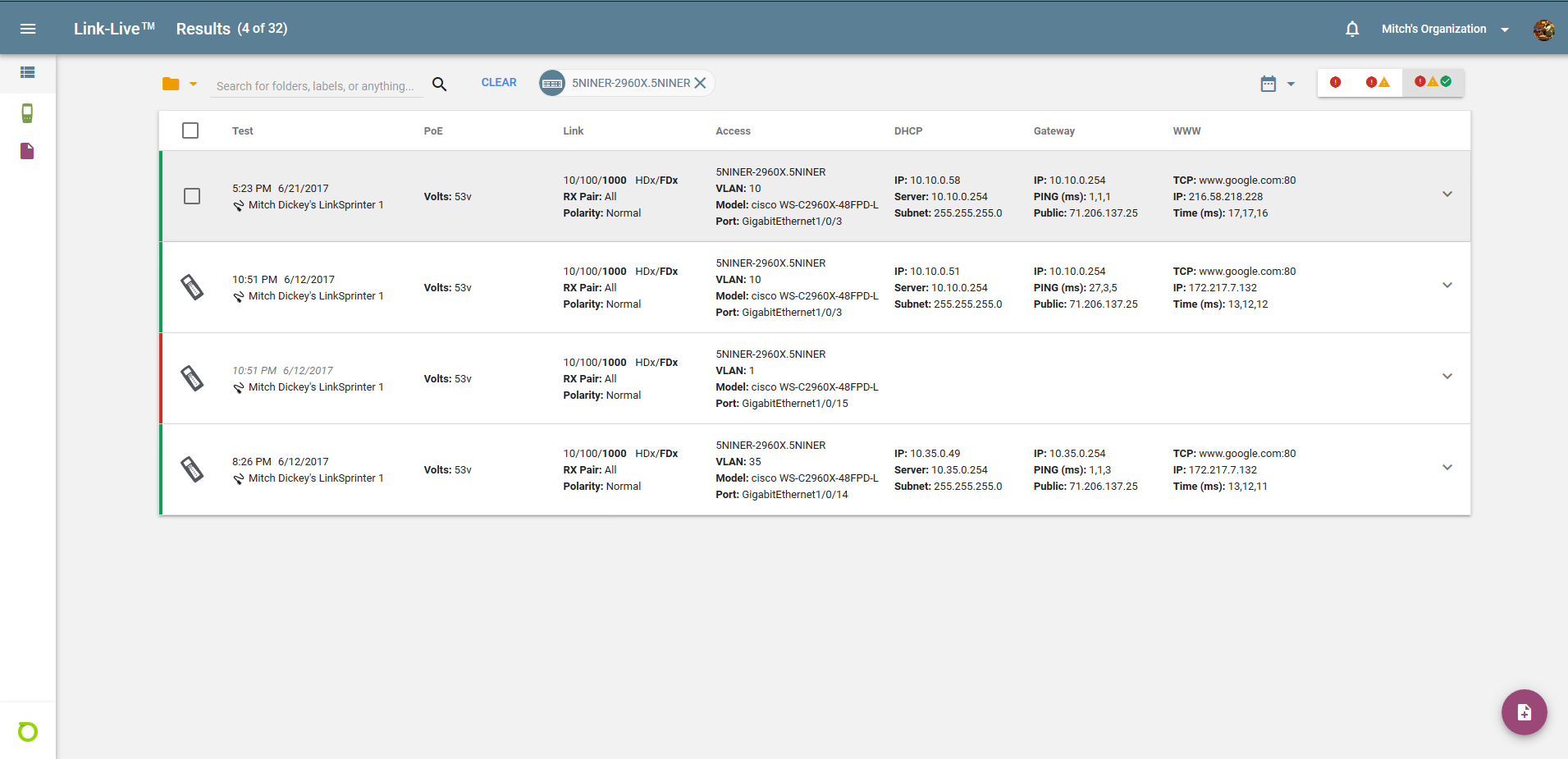
Chris also gave us a quick demo of the Link-Live dashboard. The Link-Live dashboard is a clean, easy to read area where you can collect the information that your various NETSCOUT tools gather. I have had the opportunity to use the Link-Live dashboard with my LinkSprinters for some time and I appreciate the simple layout. I can quickly get the information I need with a quick glance. The dashboard organizes your tests into a table and allows you to make annotations, as well as create reports from the collected data. NETSCOUT has definitely spent some time refining the layout making it easy to get the information you need from your test equipment.
 I have been drooling over the AirCheck G2 since it was released. We recently purchased one for work so I have only recently had the opportunity to use it on a regular basis. I love the features of the G2 especially the touchscreen and well laid out menus. The testing features are straight forward. The G2 is hands down the first device we go to when we get called out for wireless issues. The G2 saves us a significant amount of time troubleshooting. Before the G2, troubleshooting wireless issues took much longer. These handheld testers bring you to a solution much faster with the information that they supply. I personally own the G2’s predecessor, the **Fluke AirCheck. The original AirCheck is still very useful to me because it is able to extract a Meru/Fortinet/FortiRu AP ID out of a beacon’s information elements. This makes it very easy for me to identify an AP that is a member of a Virtual Cell (virtual BSSID). I still love my original AirCheck for this reason, but mostly because Kendall Hershey gave it to me. I am told that they will look into adding the FortiRu information element to the G2 in the near future.
Gratuitous NETSCOUT AirCheck G2 product placement by Brett (@crabby_fi) The AirCheck G2 has been, and continues to be, a staple in the WLAN professional’s bag of tools. The NETSCOUT product line is built on a solid platform and is sure to deliver for the foreseeable future. Anyone who uses a G2 will let you know how much it enhances their troubleshooting experience. Issues that may have previously taken a few hours to figure out are easily diagnosed in a much shorter time period. NETSCOUT is another one of those companies who I hold near and dear to my heart because they listen to their customers. I am looking forward to what NETSCOUT has coming in the future.
Blogs about the NETSCOUT G2 from my MFD2 peers:
Lee Badman – https://wirednot.wordpress.com/2017/08/06/catching-up-with-netscout-on-their-flagship-wlan-support-tool/
Clear to Send – https://www.cleartosend.net/cts-087-aircheck-g2-w-netscout-mfd2/
**On July 14, 2015, the following products from Fluke Networks were merged with NETSCOUT Systems; Visual TruView™, OptiView® XG, OneTouch™, LinkSprinter™, LinkRunner™, AirMagnet™ and AirCheck™. Fluke Networks continue to retain the DTX CableAnalyzer™, Versiv Cabling Certification System, LinkWare™ Live and Telecom products.
-
Through the Mist; Predictable, Reliable, and Measurable Wifi from Mist Systems

I recently had the opportunity to listen to a presentation from Mist Systems at Mobility Field Day 2 in San Jose. At first glance/listen Mist might sound like just another controller-less “cloud” wifi solution that touts a shiny dashboard and user analytics. They even toss around trendy new buzzwords such as “AI” and “machine learning.” I was pleasantly surprised to find out that they are much more than that!
Mist is relatively new to the wifi game but their short lived heritage is backed by staff who have worked for the likes of Cisco, Motorola, Symbol, Airespace, Zebra, and Ubiquiti to name a few. As you can tell their staff are seasoned professionals that have worked with companies with a very solid track record. With a list of leaders like this I was confident they would be able to do wireless well, but I was still curious what would differentiate them from other offerings. It didn’t take long to realize their pedigree and vision, when put together, sound as if they can break through the often “cloudy” (pun intended) traditional stalwarts. Their current customer base is impressive, including several very large organizations that span several different verticals.
After a few moments into the introduction given by Jeff Aaron, you realize that Mist isn’t just another controller-less wifi company. Jeff pointed out that Mist has two main objectives:
- Bring wifi into the modern smart device era by:
- giving data that allows an engineer to be proactive
- providing predictive recommendations
- allowing better visibility into the user experience
- not traditional network visibility, but focus on user experience
- making wifi more predictable, reliable, and measurable
- Expand wireless. Make wifi work for you. Wireless as a Service
- in addition to wifi, providing an indoor personalized location based experience
- combining wifi and BLE into one platform
You might think that others are doing very similar things but Mist was the first to implement AI and machine learning. Lee Badman, one of my co-horts at MFD, said it best when he said “Mist is the real deal when it comes to Machine Learning, etc- where the message feels forced with other vendors.”
Next to speak was Bob Friday. Bob has a rich history of providing location based services in the wireless environment. Bob was co-founder of Airespace, a wireless networking company who was the first to offer integrated location based services in their products. Bob went on to explain that wireless has transitioned from just providing wifi into an “end to end” service. Bob made it very clear that the Mist location services were built from the ground up and that it wasn’t just a “BLE laid on wifi” afterthought.
One of the coolest things I got from Bob is that Mist actually employs data scientists to analyze the data that is collected. He said that Mist has Particle Physicists and professors (you know, people who are actually good at sifting through data) going through and helping with design of the Mist product. We have all seen a nice dashboard that is spewing data all over the place. The data may have a nice presentation but is often to much or to little, and then all wrapped up in a pretty box. It is clear that Mist wants the data to be clear and easy to read, as well as useful.
Mist really seems to be ahead of the game with their vBLE location services. It didn’t take me long to realize that there are many use cases spanning several verticals for virtual beacons. App developers can use these virtual beacons to interact with applications designed for all sorts of devices. Applications can use location data to relay relevant information to the device owner based on the location of the device. Some examples include way-finding at your favorite ball park or sending offers or discounts to a customer when they are near a particular product in a retail store.
Mist’s dynamic packet capture is something I think is an absolute game changer. Mist is able to leverage it’s services to detect problems on the wireless network and then collect a packet capture in real-time. We have all been called out to troubleshoot problems at one time or another and by the time we get to the site, the problem has disappeared or changed. When Mist detects an issue, it automatically starts a packet capture. Being able to gather packets immediately when a problem is detected can potentially solve a problem in a matter of minutes where in the past it may have taken several hours.
One other notable feature is Mist’s ability to give meaningful and measurable data that makes it easy to show whether or not Service Level Expectations (SLEs) are being met. Based on the information given in the dashboard it is easy to tell which clients are having trouble connecting or are failing to connect. Being able to evaluate access point health, coverage, capacity, and throughput are also a major advantage for any wifi engineer and are all easily found in the dashboard.
Overall, I thought Mist was very impressive. They are doing things with their product that can make life as a wifi engineer easier. There is no better judge of a wireless network than the actual user experience and it is obvious that is where Mist is focusing their efforts. I am familiar with BLE but overall I am generally “green” and have lots to learn. What I do understand about Mist’s vBLE is that it has potential to be very powerful. I plan on digging a little deeper into vBLE when I get an opportunity. Having listened to Jeff Aaron, Bob Friday, and Sudheer Matta, I can tell they are confident and passionate about Mist. I am hoping to hear more from them in the near future. For now, please watch their presentation from Mobility Field Day 2. There is a lot more impressive information in their presentation. I hope you find Mist as intriguing as I did.
Check out what other #MFD2 delegates are saying about Mist:
Jake Snyder – Mist Systems: A first look
Lee Badman – Mist Systems Polishes Their Message at Mobility Field Day2
Lee Badman – Mist Systems is the Cloud WLAN Vendor With a (not so) Secret Weapon
- Bring wifi into the modern smart device era by:
-
Mobility Field Day 2
The excitement for MFD2 has been building for awhile now and I can tell you we are in store for a great couple of days. I have been looking forward to this event since I accepted the invitation to be a delegate a couple of months ago. After coming together for dinner tonight as our first time as a group, I am even more excited for all that is in store.
Here is the lineup:
Mist Systems – July 25, 2017 at 10:00 – 12:00 PST
I have had a chance to play around with one of Mist’s APs over the past couple weeks and I found it to be very intuitive and easy to set up. It took no time at all to get an SSID on the air and clients connected. The available data on the dashboard is very helpful/useful. I am looking forward to getting a deeper dive into the BLE features of the device.
Mojo Networks – July 25, 2017 at 2:00 – 4:00 PST
Mojo Networks, formerly AirTight, has gone through several changes over the last couple years. They have changed their direction and I am looking forward to hearing more about their plans going forward. They had an excellent presentation at WirelessLAN Professionals conference this past February.
Cape Networks – July 26, 2017 at 9:00 – 10:00 PST
Cape is a company that I am not real familiar with yet and I am very interested to see what they have lined up. I did see their presentation at WLPC but haven’t had a chance to work with their gear yet.
Nyansa – July 26, 2017 at 10:30 – 12:30
Another company that I am really looking forward to hearing more from is Nyansa. From what I have seen, they are able to take wireless client data and present it to an engineer in an easy to read format to get a better understanding of what is actually going on in the wireless network. You can find their presentation from WLPC here.
Netscout – July 26, 2017 at 2:00 – 4:00 PST
The AirCheck G2 is our go to tool in the field when a wireless problem is reported at work. I am excited to hear what they have in the pipeline for the future. I am also pumped that we get to see our good friend Kendall Hershey. A couple of us had the pleasure of meeting and hanging out with her at Cisco Live 2016. Her and I both missed this year’s Cisco Live so it will be cool to see her again.
Being able to watch and listen to presenters at previous Wireless/Mobility Fields days and interact with the delegates was something I looking forward to. With this being my first MFD, I would be lying if I said I wasn’t a bit nervous but I am with a great group of professionals so I am sure it will go great! I am very excited for the next two days as they will be packed from the beginning of the day until the end with all kinds of great information and maybe some surprises.
Please feel free to follow along on the Mobility Field Day page here.
Please also feel free to interact with me or any of the other delegates listed in the above link. Interacting with the delegates was almost as fun as listening to the presenters in my past experiences. If you have any questions you would like to see asked of the presenters, feel free to reach out to any of us delegates via Twitter. Make sure to also use the hashtag #MFD2.
In the weeks to come I will be releasing blog posts about the presentations so make sure to check those out when they are released.